Tendências e Mercado
27 de mar. de 2026
Go back
We replaced spreadsheets with a real system (and it changed everything)
Autor: Rafael Lins
How we replaced spreadsheets with a real system using React, Node and SQLite—and what changed in our marketing operations.

At some point, spreadsheets stop being helpful.
And start becoming your bottleneck.
That’s exactly what happened in our marketing operation at Ad Rock.
The problem wasn’t tools
We weren’t “disorganized”.
We had:
structured spreadsheets
clear workflows
defined processes
And still, things didn’t scale.
The real issue was:
we had no system — only documents
What broke first
As we grew, we started seeing:
duplicated work
inconsistent campaign setups
loss of historical decisions
dependence on team memory
lack of traceability
Every new client increased complexity non-linearly.
The key realization
The problem wasn’t execution.
It was architecture.
We were treating:
briefings as files
campaigns as sheets
ads as text
Instead of:
entities
relationships
state
The decision
We stopped trying to “organize spreadsheets”.
And decided to build a system.
Not a SaaS.
Not a product.
A system for our own operation.
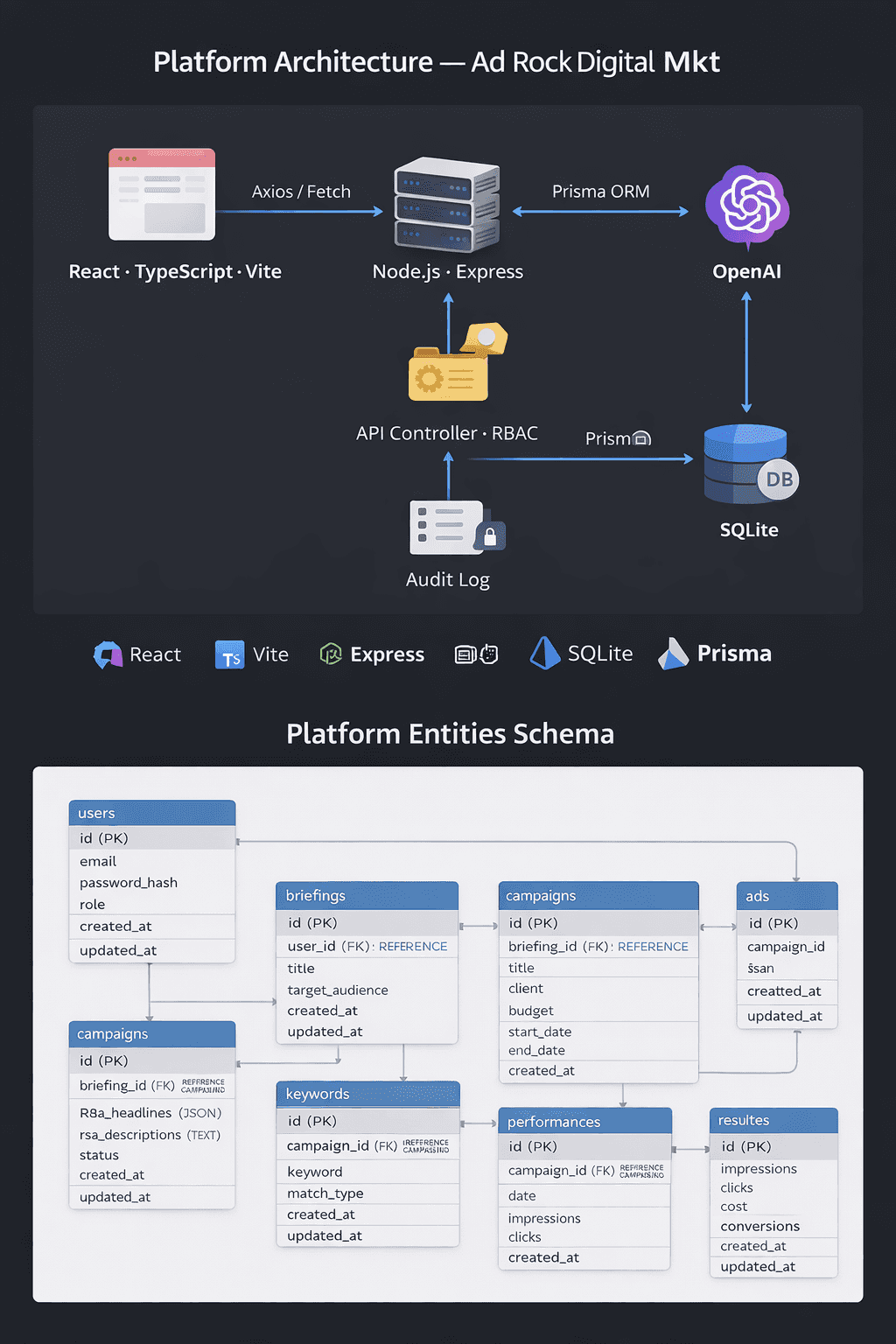
The stack
We intentionally kept it simple:
React + TypeScript + Vite
Node.js + Express
SQLite
Session-based authentication
Role-based access control
Audit logging
No overengineering.
The hardest part (not what you think)
Building UI is easy.
Connecting APIs is easy.
The hardest part was:
defining the data model
From documents to entities
Before:
a campaign was a spreadsheet
a keyword list was a file
performance was external
After:
campaigns → entities
keywords → entities
ads → entities
performance → entities
Everything connected.
What this unlocked
Once we had real state:
we could track changes
we could audit actions
we could standardize execution
we could automate safely
Authentication actually matters
Most internal tools fake auth.
We didn’t.
We implemented:
server-side sessions
permission-based modules
controlled access per feature
Because:
internal tools without governance break at scale
Audit logs changed everything
This was unexpected.
Once we added audit logs:
we could trace decisions
we reduced operational errors
we improved accountability
This alone justified the system.
AI belongs in the backend
We integrated AI (OpenAI) at the backend level.
Not in the frontend.
Reasons:
control
consistency
security
cost management
AI became a layer, not a feature.
What we didn’t do
We avoided:
microservices
complex infra
premature scaling
unnecessary abstractions
This is not a product.
It’s an operational system.
Current limitations
Still early in some areas:
no full Google Ads API integration yet
UI still evolving
some workflows partially manual
But the foundation is solid.
What changed
Before:
execution depended on people
After:
execution depends on system state
The biggest lesson
Spreadsheets are flexible.
Systems are reliable.
And at scale:
reliability beats flexibility
Why this matters
If your operation depends on:
Notion
Google Sheets
manual workflows
You don’t have a system.
You have distributed memory.
And that doesn’t scale.
What’s next
We’re evolving this into:
Google Ads API integration
automated campaign generation
centralized analytics
deeper AI integration
Final thought
We didn’t build software.
We built infrastructure for decision-making.
And that changed everything.
Full case (PT-BR)
👉 https://adrock.com.br/blog/ad-rock-sistema-interno-gestao-marketing





Go back